
Why Pure-Play Online retailers Are Embracing Physical Stores
Once a digital disruptor, Wayfair is redefining how Americans shop for home goods, blending inspiration with immediacy through physical retail. This is the Great Retail Reversal—a global pivot where digital-native brands like Wayfair, Nykaa, Lenskart, Caratlane, and Warby Parker are embracing brick-and-mortar to survive, thrive, and reconnect with customers in ways screens cannot. Once poised to replace physical stores, e-commerce is finding its future in the very spaces it challenged.
A Retail Revolution Unfolds
In the early 2000s, a digital wildfire transformed retail, reshaping global shopping habits. From a modest Seattle garage, Amazon reimagined commerce, starting with books and expanding to electronics, apparel, and groceries. Warby Parker disrupted eyewear with $95 designer frames sold online, bypassing traditional opticians. Casper promised better sleep, delivering mattresses in compact boxes. In India, Nykaa revolutionised beauty retail, offering thousands of products with doorstep convenience. These pure-play e-commerce brands leveraged the internet’s global reach, low costs, and data-driven personalisation to outmanoeuvre traditional retailers often mired in legacy systems and slow to adapt to the digital age.
The formula was simple yet powerful: no expensive leases, minimal staffing, and algorithms replacing sales associates. Warehouses supplanted storefronts, enabling rapid scaling without real estate burden. Digital-only players like Wayfair, ASOS, JD.com, and Alibaba thrived globally, capturing consumer imagination with vast selection, competitive prices, and convenience. By 2024, global e-commerce topped $6 trillion, with India projected to hit $300 billion by 2030.[1] Physical stores, weighed down by high rents, declining footfall, and operational inefficiencies, seemed like relics of a bygone era. Retail giants like Sears and J.C. Penney shuttered thousands of locations, and the narrative was clear: e-commerce was the future, and brick-and-mortar was on its way out.
Beneath the digital dazzle, cracks emerged. Customer acquisition costs skyrocketed, with Meta and Google ad rates rising over 10% annually between 2021 and 2023, according to WordStream and Statista.[2] Returns plagued tactile categories like apparel, footwear, cosmetics, and furniture, where rates hovered at 20–25%, per the National Retail Federation, hurting margins and logistics systems. Despite advancements in AI-powered recommendations, virtual try-ons, and augmented reality, online shopping could not fully replicate the sensory and emotional experience of in-person retail. A 2021 McKinsey survey revealed 66% of global shoppers preferred to see, touch, and feel products before buying—especially in emerging markets like India, where physical interaction drives trust and decision-making for high-value purchases like jewellery and cosmetics.[3]
The industry took note, and a surprising shift emerged. Once-digital-only brands began embracing physical stores. Wayfair launched its first large-format store in Chicago in 2024, offering immersive displays to inspire furniture purchases. Nykaa, India’s beauty e-commerce titan, opened Luxe and On Trend boutiques, where customers could swatch lipsticks, test fragrances, and enjoy guided consultations, restoring the serendipity of beauty shopping. CaratLane, a Tanishq-backed online jeweller, adopted a “phygital” strategy, blending digital selection with in-store fittings and advice. Lenskart, an Indian eyewear disruptor, scaled to over 550 stores across India and Southeast Asia, providing fittings, eye tests, and same-day delivery. Even global giants like Alibaba and JD.com, once champions of digital disruption, pivoted to physical formats with Hema supermarkets and 7FRESH stores, respectively, blending cutting-edge technology with tactile experiences.
This was a global phenomenon, signalling that e-commerce, once heralded as the end of physical retail, was merely a powerful yet incomplete phase. The industry came full circle: digital-first brands embraced physical stores to scale smarter, serve better, and stay profitable. Meanwhile, traditional retailers like Walmart, Target, and Kroger invested heavily in omnichannel strategies, seamlessly integrating digital and physical operations to reclaim market share and challenge pure-play models. The Great Retail Reversal raises a fundamental question: can digital-native retailers achieve lasting profitability through physical expansion, or are omnichannel incumbents rendering them irrelevant?
Can the Offline Pivot Drive Profitability for Pure-Plays?
For over a decade, pure-play e-commerce brands scaled rapidly by capitalising on low fixed costs, personalised marketing, and global digital reach. However, profitability remained elusive for many. High customer acquisition costs, soaring return rates, and weak customer stickiness exposed the limits of the digital-only model. A new playbook is emerging physical stores offer a path to sustainable margins, deeper customer loyalty, and operational efficiencies. The pivot is bold, but it comes with significant risks and complexities that demand precision and discipline.
– Reducing Returns, Increasing Touch
E-commerce’s Achilles’ heel has always been returns, particularly in tactile categories like furniture, eyewear, fashion, and cosmetics, where return rates range from 15% to 40%. The inability to touch, try, or feel products often leads to disappointment, clogging logistics systems and eroding margins. Physical stores address this challenge head-on by enabling customers to validate purchases before buying. Wayfair’s Chicago flagship, where shoppers can test furniture in curated displays, led to a 20% drop in returns, according to CEO Niraj Shah. Warby Parker’s stylish showrooms let customers try on frames, reducing returns by 15%. Casper’s in-store mattress trials, allowing shoppers to test comfort levels, cut returns by 30%. In India, Nykaa’s Luxe boutiques bridge trust gaps in a market where sensory interaction is critical for high-value beauty purchases, boosting conversion rates and reducing costly returns.
The tactile advantage is particularly vital in emerging markets like India, where digital trust for premium goods remains low. The 2021 McKinsey study highlighted that 66% of global consumers prefer physical interaction before purchasing high-consideration items, a trend amplified in India due to cultural preferences for sensory validation.[4] For brands like Nykaa and Lenskart, physical stores aren’t just about sales—they build confidence and bridge the trust gap that online channels struggle with. This sensory connection reduces returns and enhances customer satisfaction, fostering repeat purchases and brand loyalty.
– Stores as Amplifiers, Not Just Retailers
Physical stores do more than drive transactions—they amplify brand visibility and equity in ways that digital channels alone cannot. Wayfair’s Chicago flagship, with its immersive showrooms, inspires customers to visualise their homes, enhancing brand equity in a category where online grids often fall short. In India, Nykaa’s Luxe and On Trend formats boosted brand awareness by 25%, according to its FY24 investor report, particularly in Tier 2 and Tier 3 cities like Lucknow and Indore, where digital salience is limited.[5] These stores act as living billboards, capturing attention, conveying trust, and appealing to aspirational shoppers who may not trust online channels for premium purchases. For example, a customer visiting a Nykaa boutique to test a luxury skincare product is more likely to trust the brand’s online offerings, creating a halo effect that strengthens digital sales.
This amplification is critical in markets where brand trust is a barrier . In India, where over 55% of beauty and fashion demand comes from Tier 2 and Tier 3 cities, per RedSeer Consulting,[6] physical stores allow brands to localise their presence and build deeper connections. Similarly, in the U.S., Wayfair’s physical presence helps it compete with traditional furniture retailers like IKEA, whose showrooms have long set the standard for experiential retail. Stores convey authenticity, aspiration, and immediacy, turning casual browsers into loyal customers and driving brand equity in ways that digital ads struggle to replicate.
– Omnichannel Shoppers Spend More
The data is unequivocal: customers who engage across both online and offline channels are more valuable. A 2024 Bain & Company report found that omnichannel shoppers spend 10–15% more and are 25% more loyal than online-only buyers. CaratLane, India’s online jewellery retailer, attributes 60% of its online purchases to in-store influence, with consultations driving loyalty and repeat purchases. The COVID-19 pandemic shifted consumer behaviour towards digital, but the pendulum has swung back: PwC’s 2023 Global Consumer Insights Pulse Survey found that 44% of global consumers had resumed in-store shopping, seeking experiences that combine the convenience of online with the connection of physical retail.[7] For digital-native brands, integrating online and offline touchpoints creates a virtuous cycle of engagement, retention, and higher lifetime value.
This trend is particularly pronounced in high-consideration categories. A customer researching furniture online at Wayfair might visit the Chicago store to test a sofa’s comfort, then complete the purchase online with confidence, often adding complementary items like lamps or rugs. This omnichannel journey increases basket sizes and fosters loyalty, as customers feel supported across channels. Similarly, Nykaa’s in-store beauty advisors guide customers through complex purchases, like finding the perfect foundation shade, which translates into higher online repeat purchases. The omnichannel advantage lies in its ability to blend discovery, trust, and convenience, creating a seamless experience that drives both sales and loyalty.
– Physical Stores as Fulfilment Engines
Beyond branding and customer experience, physical stores are evolving into powerful logistics hubs, creating synergies that enhance operational efficiency. Savills’ 2024 study estimated that click-and-collect models can reduce delivery costs by up to 50%, a significant advantage in an era of rising logistics expenses.[8] Wayfair’s Chicago store doubles as a fulfilment centre, streamlining last-mile delivery and reducing returns by allowing customers to validate purchases in person. Lenskart’s 550+ stores in India drive 35% of revenue through store-enabled logistics, offering same-day delivery that competes with pure e-commerce speed. Zalando’s Connected Retail program, which enlists 4,000 independent shops across Europe to fulfil online orders and offer buy-online-pickup-in-store (BOPIS), proves that stores can deliver omnichannel benefits without heavy real estate investments. These models not only lower costs but also enhance customer satisfaction by offering immediacy that pure e-commerce struggles to match.
The fulfilment role of stores is particularly transformative in markets with complex logistics. In India, where last-mile delivery can be hindered by urban congestion or rural inaccessibility, Lenskart’s stores serve as micro-fulfilment centres, ensuring rapid delivery and reducing return rates. In the U.S., Wayfair’s store-enabled logistics help it compete with Amazon’s speed, offering customers the option to pick up orders the same day. This integration of physical and digital operations creates a competitive edge, allowing brands to deliver faster, cheaper, and more reliably than online-only models.
– Human Touch Drives Data Depth
Physical retail unlocks insights that algorithms alone cannot capture. In-store interactions—how customers touch, try, or linger over products—provide rich behavioural data that fuels more personalised digital journeys. Bonobos, the U.S.-based menswear brand, found a 15% higher repeat purchase rate among customers who visited its stores, using in-store insights to refine online targeting and recommendations. Nykaa’s beauty advisors collect nuanced feedback on customer preferences, informing digital content from tutorials to product launches. This human touch bridges the emotional and analytical, creating a feedback loop that enhances customer lifetime value and strengthens brand loyalty.
A customer trying on glasses at a Lenskart store might reveal preferences for lightweight frames, which the brand can use to tailor online recommendations. Similarly, Wayfair’s in-store designers observe how customers interact with furniture layouts, feeding insights into its online algorithm to suggest complementary products. This blend of human observation and data analytics allows brands to create more relevant, engaging experiences, driving both online and offline sales.
But Profitability Is Not a Given
For all its promise, the offline pivot introduces a new level of complexity and risk. Fixed costs—real estate, staffing, inventory, and visual merchandising—add up quickly. Wayfair’s Chicago flagship required a $10 million investment, exposing it to margin pressure if footfall disappoints, particularly in premium urban locations where rents are high. Execution is critical: disjointed inventory, inconsistent pricing, or poor service can erode brand trust. BlueStone, an Indian jewellery retailer, learnt this the hard way, with inventory mismatches across its 50 stores leading to a 15% return rate and customer frustration. Macroeconomic headwinds further complicate the picture. From 2023 to 2025, global inflation surged, peaking at 8.2% in the U.S., according to the IMF, while Redfin reported U.S. housing turnover hitting a 30-year low—a red flag for furniture retailers like Wayfair. These pressures make store-level profitability harder to achieve.
The competitive landscape has also intensified. Omnichannel giants like Walmart, Target, and Kroger are leveraging their store networks, loyalty programs, and logistics scale to dominate on price and convenience. Walmart, for instance, captured 7.3% of the U.S. e-commerce share in 2023, according to eMarketer[9], tightening the screws on pure-play players. Overexpansion is another risk. Pepperfry’s attempt to scale to 70 “Studio Pepperfry” stores in India led to a ₹187 crore loss in FY24, driven by poor site selection, unclear positioning, and operational inefficiencies. The lesson is clear: physical expansion without discipline can turn promising stores into liabilities, draining resources and damaging brand perception.
Profitability across Retail Models: Why Stores Still Matter
Retail’s brutal math is unforgiving: sales alone don’t build great companies—sustainable profitability does. For over a decade, digital-native disruptors like Allbirds, Nykaa, and Warby Parker captivated investors with sleek online models, proprietary products, and loyal customer bases. Yet, many struggled to turn explosive growth into lasting profits. The core issue lies in the economics of the pure-play e-commerce model itself. According to AlixPartners, online-only retailers spend 10–30% of revenue on marketing and 15–25% on fulfilment.[10] Add return rates that soar to 30–40%, which can erase up to 10% of top-line revenue, and the margin math becomes grim. As retail analyst @R_H_Investing bluntly put it on X, “Pure-plays desperately need stores to survive.”
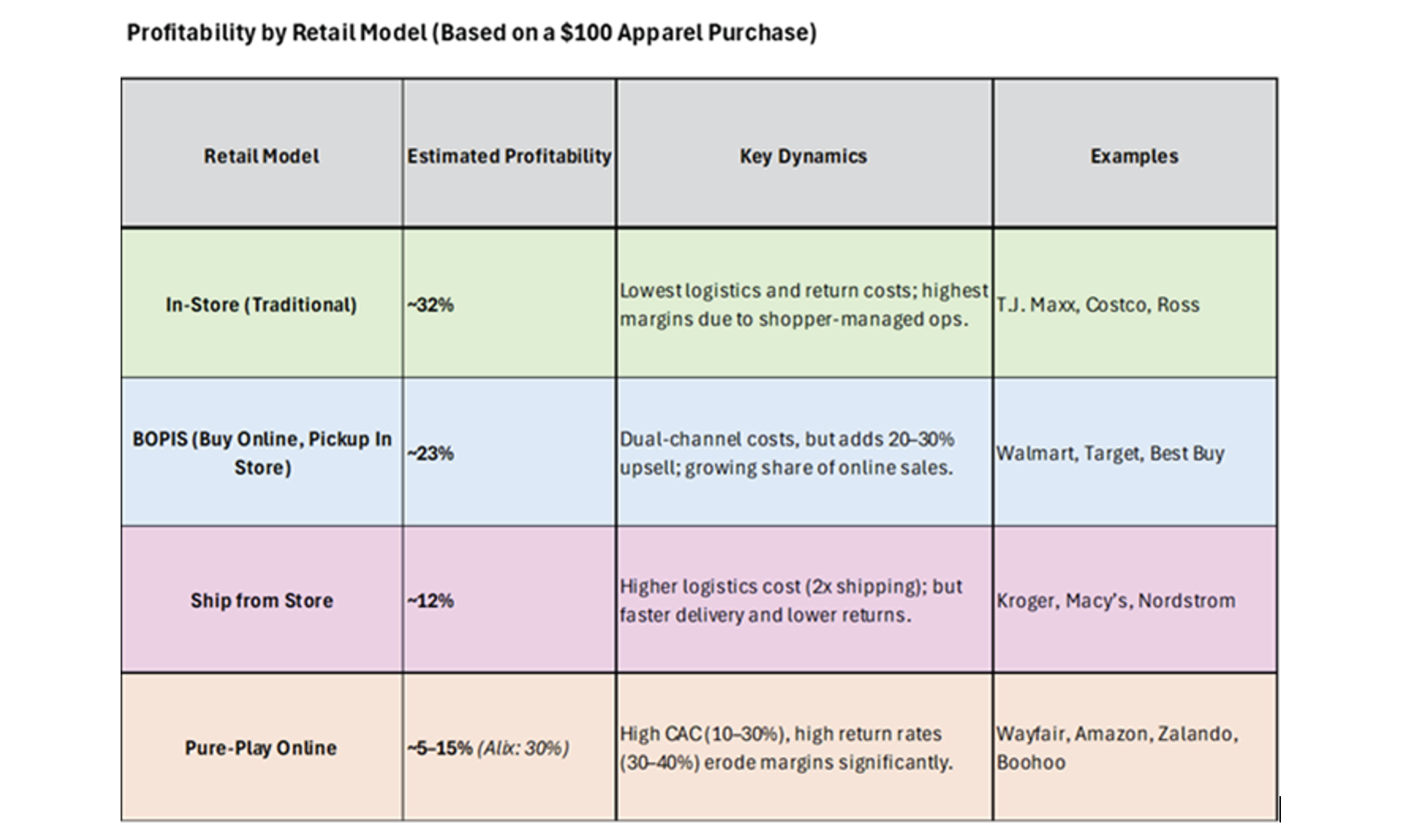
Note: AlixPartners’ reported profitability for pure-plays may overestimate viability. Other analyses, such as McKinsey and Retail Dive, suggest far thinner margins, especially in discretionary categories like apparel and home.
This isn’t just a theory—it’s a reckoning. Former e-commerce darlings like Wayfair, Bonobos, and even Amazon have turned to physical retail to stabilise margins and stem return-related losses. Wayfair’s Chicago flagship, for instance, not only reduced returns by 20% but also lifted digital sales by 10%, showing how stores enhance both profitability and online performance. This phenomenon spans the U.S., India, Europe, and Southeast Asia, signalling a global comeback for physical retail. In India, Nykaa’s stores cut return rates by 18%, while Lenskart’s outlets drive 35% of revenue through store-enabled logistics, proving that physical presence can transform the economics of e-commerce.
Meanwhile, store-based incumbents are proving that physical retail, far from being a relic, is a digital-era advantage. According to eMarketer, seven of the top ten U.S. online retailers in 2023 were legacy brands—Walmart, Target, Kroger, and others—that built omnichannel ecosystems by embedding logistics, fulfilment, and service into their stores. These aren’t just showrooms; they’re powerful, flexible operating assets that spread costs across physical and digital touchpoints. Jason Goldberg, Chief Commerce Strategy Officer at Publicis, explains, “Omnichannel retailers win because they already have the infrastructure. They can leverage stores to reduce costs and enhance customer experiences, unlike pure plays facing margin compression from every direction.”
A 2023 AlixPartners study on the unit economics of a $100 apparel transaction offers a stark comparison: hybrid models consistently outperform online-only approaches, especially when powered by Buy Online, Pick Up In Store (BOPIS). McKinsey notes that BOPIS customers spend 20–30% more during pickup trips, often adding impulse purchases like accessories or decor. Forrester projects BOPIS will account for half of U.S. online sales by 2025, fusing the efficiency of online ordering with the immediacy of brick-and-mortar. For example, Target’s Drive-Up service, where customers pick up online orders without leaving their cars, has driven significant incremental sales, as shoppers often add items during pickup. As Jill Standish, Global Head of Retail at Accenture, warns, “If you’re doing 50% of your business online, you’ll see volume—but not profitability—without stores.” In a retail landscape shaped by rising costs, demanding customers, and razor-thin margins, stores are no longer optional—they’re essential to sustainable profitability.
The Offline Enigma: Amazon’s Physical Bet Didn’t Fully Pay Off
When Amazon acquired Whole Foods for $13.7 billion in 2017, it sent shockwaves through Wall Street and Silicon Valley. The company that declared war on brick-and-mortar was now investing in it, followed by the launch of Amazon Go, a cashierless concept built on “Just Walk Out” technology. By 2025, Amazon projects over 500 Go and Fresh stores globally, aiming to create a seamless physical extension of its digital supremacy. But the results have been mixed. Physical retail accounts for just 15% of Amazon’s projected $600 billion in 2024 sales, according to Bloomberg. High setup costs—$1–2 million per Go store—and technical glitches, like misread sensors and unrecorded charges, have frustrated customers, as evidenced by waves of complaints across social platforms in 2024.
What sets Amazon apart is its diversified growth model. AWS, its cloud business, generated $100 billion in 2024, accounting for over 70% of operating income. Prime, with 200 million global members, drives retention and increases order frequency and basket size. Healthcare, through acquisitions like One Medical and Amazon Pharmacy, unlocks high-margin verticals. In this ecosystem, physical stores are not the profit centre but a support mechanism—brand billboards, last-mile logistics nodes, and Prime enablers. While pure-play retailers like Wayfair rely on stores to stabilise margins, Amazon’s resilience lies in its multi-engine model, making its offline pivot a strategic enabler rather than a make-or-break bet.
Clicks to Bricks: A Tale of Triumphs—and Tumbles
As digital retailers matured, the rules of retail changed. Customer acquisition became expensive, competition grew fierce, and loyalty proved elusive. Physical stores emerged as a solution, blending e-commerce efficiency with the tangibility and trust of in-person retail. Some brands executed this pivot masterfully; others stumbled, offering lessons in what it takes to bring a digital brand into the physical world.
– Nykaa: Beauty’s Omnichannel Star
Founded in 2012 by Falguni Nayar, Nykaa disrupted India’s beauty industry with a digital platform hosting over 2,400 brands. Its AR-based “Try On,” video tutorials, and influencer content built a loyal Gen Z and millennial audience. Recognising digital’s limits, Nykaa opened its first Luxe store in Delhi in 2014. By 2025, it will operate 200+ stores across 70 cities, including compact “On Trend” formats aimed at younger shoppers. Offline contributes 30% of retail revenue, with return rates dropping by 18%. QR-linked product discovery and the Nykaa Privé loyalty program boost customer lifetime value by 25%, proving that stores amplify digital success while enhancing brand equity in smaller cities like Jaipur and Surat.
– Lenskart: Seeing Omnichannel Clearly
Launched in 2010, Lenskart disrupted India’s eyewear market with affordable, stylish frames sold online, challenging offline chains like Titan Eye+. But vision correction demands physical validation. In 2014, it opened its first store, scaling to 550+ across 30+ cities by 2025. In-store eye tests and try-ons reduced return rates by 15%, while omnichannel customers spent 20% more on average. Lenskart’s data-driven expansion into Tier 2 cities like Moradabad and Nagpur has broadened its footprint, though occasional operational strains, flagged on social media, highlight the challenges of rapid scaling.
– CaratLane: Digital Diamonds, Physical Trust
Founded in 2008, CaratLane reimagined jewellery retail in India, bringing fine jewellery online in a market where physical inspection is paramount. By 2011, it launched stores, scaling to 325 in 67 cities by 2025. In-store consultations cut returns by 20%, with 60% of digital orders influenced by store visits. Following Titan’s 2016 acquisition, CaratLane turned early losses into sustainable success, achieving ₹166 crore in FY23 EBITDA, thriving even in smaller cities like Navsari.
– Warby Parker: Rewriting Eyewear Retail in the U.S.
In 2010, Warby Parker revolutionised U.S. eyewear with $95 designer frames sold online. But the need for try-ons led to its first New York showroom in 2013. By 2025, it will operate 200+ stores, contributing 40% of revenue. Showrooms reduced returns by 15% and boosted retention by 12%. In-store tablets connect visitors to online inventory, creating a seamless hybrid journey. High urban rents squeeze margins, but showrooms cut logistics costs and foster community engagement, keeping Warby Parker ahead in the omnichannel race.
– Wayfair: From Browsers to Showrooms
Wayfair, one of the largest online furniture retailers, long resisted physical expansion. But in 2024, it launched its Chicago flagship, offering curated displays to inspire purchases. Returns fell by 20%, and digital sales rose 10%, according to CEO Niraj Shah. However, furniture retail demands –+significant capital, especially in premium urban spaces. Wayfair’s future in physical retail hinges on consistent footfall and deeper omnichannel integration to offset high costs.
– Alibaba’s Hema: Redefining “New Retail”
Alibaba launched Hema (now Freshippo) in 2016 to pioneer “New Retail,” fusing online, offline, logistics, and data. By 2024, Hema’s 500+ locations earned over $6 billion. Customers order via app, check out via phone, and get 30-minute deliveries within 3-km. In-store sampling and real-time data cut food waste by 25%. However, rising setup costs and competition from players like Meituan curb profitability, making Hema a bold but challenging bet.
– Zalando: Owning Omnichannel Without Owning Stores
Europe’s top fashion e-tailer, Zalando launched Connected Retail in 2018, partnering with 4,000 independent shops across Europe to fulfil online orders and offer BOPIS, Zalando boosted store-sourced sales 12.7x year-over-year in 2024. Return rates dropped by 18%, and same-day delivery became scalable without real estate costs, offering startup-like efficiency with omnichannel scale.
– When Omnichannel Goes Off Track: Cautionary Tales
Pepperfry’s attempt to scale to 70 “Studio Pepperfry” stores in India led to a ₹187 crore loss in FY24, driven by poor site selection and low footfall. BlueStone struggled with inventory mismatches across its 50 stores, resulting in a 15% return rate and ₹167 crore in FY23 losses. Boohoo’s London pop-ups failed to draw crowds, contributing to a 17% profit drop in 2023. Nasty Gal’s two LA stores in 2015 preceded its 2016 bankruptcy, undone by poor strategy and cost blowouts. These cautionary tales underscore that offline success demands strategic alignment, operational rigour, and local relevance.
The Physical Store Strikes Back: How Traditional Retailers Are Winning the Omnichannel War
For years, the retail narrative was dominated by a single story: digital disruption would kill the physical store. However, in 2024, traditional retailers are orchestrating one of the greatest comebacks in retail history, turning sprawling store networks into omnichannel powerhouses that outpace pure-play digital natives.
Walmart: From Supercentre to Superpower
Walmart, the epitome of traditional retail scale, has become an omnichannel juggernaut. Its $100 billion e-commerce business grew nearly 20% in 2024, outpacing Amazon’s. With over 4,600 stores as fulfilment hubs, Walmart offers same-day pickup and delivery to 95% of U.S. households, slashing shipping costs by up to 50%. Walmart Connect, its retail media business, generated $4.4 billion in ad revenue, monetising digital eyeballs in ways Amazon pioneered but now must defend. Capturing 7.3% of U.S. e-commerce sales in 2023, per eMarketer, Walmart is putting pure-plays like Wayfair in its crosshairs.
– Target: Blending Style with Seamless Service
Target has made convenience its weapon, blending curated assortments with operational finesse. In 2023, it generated $107 billion in revenue, with 16% from e-commerce. Drive-Up and Order Pickup, powered by 1,900+ stores, account for nearly half of digital sales. Tech-enabled infrastructure, like tablet-assisted shopping and real-time inventory checks, enhances the experience. Target’s RedCard loyalty program unifies online and offline, boosting retention by 15%. With a 2.1% share of U.S. e-commerce, Target competes on design and convenience where many pure-plays falter.
– Kroger: Groceries Get Smarter
Kroger, with $150 billion in 2024 revenue, draws 12% from e-commerce. Its 2,700+ stores support a click-and-collect model, delivering fresh goods with minimal friction. Personalised promotions via its loyalty app boost customer spend by 10%, outpacing gig-based services like Instacart. Kroger’s 1.5% e-commerce share is small but strategic, proving physical infrastructure can beat algorithmic convenience in grocery retail.
Best Buy: Human Help Meets Digital Depth
Best Buy’s $46.3 billion revenue includes 22% from e-commerce ($10.2 billion), with 40% of online orders fulfilled in-store. Geek Squad and Totaltech membership drive 12% higher retention, blending expert service with seamless pickup. Shoppers start online, get advice in-store, and check out via tablets, securing a 1.8% e-commerce share and outplaying pure digital rivals in electronics.
– Home Depot: Omni-Tools for the DIY Revolution
Home Depot’s $152.7 billion revenue reflects its strength among professionals and DIYers. Its 2,000+ stores fulfil 50% of online orders as same-day pickups. The Pro Xtra loyalty program, tailored for contractors, drives 20% higher spend through bulk pricing and job tracking. Real-time inventory across channels ensures reliability, securing a 1.9% e-commerce share.
IKEA: Where Scale Meets Seamless Integration
Long celebrated for its flat-pack ingenuity and global scale, IKEA is emerging as a quiet force in omnichannel retail. With over 470 stores across 60+ countries and a growing e-commerce footprint, IKEA is proving that size doesn’t hinder agility—it enables it.
In markets like Germany and China, online orders now account for more than 25% of total sales. IKEA hasn’t sacrificed its physical presence; instead, it’s reimagining it. City-centre planning studios, click-and-collect hubs, and app-enabled in-store navigation are redefining the big-box experience. Stores double as fulfilment centres, helping reduce last-mile costs and enabling next-day delivery in major metro areas.
By blending immersive physical experiences with digital convenience, IKEA has created a model where channels reinforce each other. The result? Higher conversion rates, more loyal customers, and a future-ready retail blueprint.
Williams-Sonoma: Premium Omnichannel Mastery
Williams-Sonoma, with $7.7 billion in 2023 revenue, draws 66% from e-commerce. Its 500+ stores offer design consultations and click-and-collect, with omnichannel customers spending 20% more. Lower digital marketing costs, due to strong organic traffic, give it an edge over pure-plays like Wayfair, proving premium positioning thrives with operational versatility.
Conclusion: It Is Inevitable—Pure-Play Online Must Go Offline
The era of digital-only retail is over. Soaring customer acquisition costs, high returns, and thin margins have pushed brands like Wayfair, Nykaa, and Warby Parker to embrace physical stores, reducing returns, building trust, and boosting loyalty. However, failures like Pepperfry, BlueStone, and Nasty Gal highlight the risks of poor execution, from bad site selection to inventory mismatches. Traditional giants like Walmart, Target, and Kroger are leading, leveraging scale, loyalty programs, and omnichannel finesse to dominate. Globally, Zalando’s Connected Retail and JD.com’s smart stores blur online-offline lines, while DTC pioneers like Casper and Allbirds hit growth ceilings, underscoring the limits of digital-only models.
The Great Retail Reversal is not about digital versus physical; it is about blending the best of both. Retail’s future is hybrid, and the competition is ruthless. Success belongs to those who can fuse technology, trust, and human connection into seamless, memorable experiences. The store isn’t just back—it’s the future.
References
- https://www.ibef.org/industry/ecommerce#:~:text=India’s%20e%2Dcommerce%20industry%2C%20valued,%2Drelated%20PE/VC%20investments
- https://www.statista.com/outlook/amo/advertising/social-media-advertising/worldwide
- https://www.indianretailer.com/article/technology-e-commerce/digital-trends/e-commerce-and-jewelry-navigating-online-retail
- https://www.mckinsey.com/industries/consumer-packaged-goods/our-insights/state-of-consumer
- https://www.indianretailer.com/news/nykaa-scales-consumer-brands-and-retail-network-eyes-rs-6000-cr-beauty-gmv
- https://redseer.com/reports/indias-beauty-industry-expanding-across-audiences-and-categories/#:~:text=In%20addition%20to%20metro%20cities,brands%20to%20expand%20their%20reach
- https://www.consultancy.in/news/3139/bain-and-flipkart-foresee-350-million-online-shoppers-by 2025#:~:text=Previous%20estimates%20from%20Bain%20have,even%20further%20into%20the%20distance
- https://impacts.savills.com/market-trends/online-returns-the-impact-of-reverse-logistics-on-real-estate.html#:~:text=Ecommerce%20returns:%20a%20complex%20and,assist%20in%20handling%20these%20peaks
- https://www.statista.com/statistics/274255/market-share-of-the-leading-retailers-in-us-e-commerce/#:~:text=Biggest%20online%20retailers%20in%20the,by%20Apple%2C%20with%203.6%20percent
- https://www.omniaretail.com/blog/ai-ads-pricing-beyond-marketing-budgets#:~:text=However%2C%20other%20sources%20estimate%20average%20e%2Dcommerce%20marketing,spending%2015.9%25%20of%20revenue%20on%20marketing%20initiatives
